


On a TPO or PVC commercial roof, the field membrane rarely fails first. The seams do. Here’s what proper welding and seam testing actually involve.
A single-ply membrane, TPO or PVC, is manufactured as a continuous sheet in wide rolls, but no commercial roof is one seamless piece. Every roll overlaps the next, and every one of those overlaps is a seam that has to be fused into a single, continuous, waterproof joint. On a large commercial roof, the total linear footage of seams can run into the miles, and every foot of it is a place the roofing membrane’s manufactured integrity depends entirely on the welding crew’s work that day, not on the material itself.
This is why, when a single-ply roof fails prematurely, the cause is disproportionately traced to seam issues rather than the field membrane simply wearing out. The membrane sheet itself is a manufactured, tested, consistent product. The seam is a field-executed joint, made under whatever weather and time pressure existed that day, and it’s only as good as the welding technique and quality control behind it. This article covers how single-ply seams are welded, how they’re tested, and why seam quality is worth scrutinizing closely on any bid or completed project.
How hot-air welding actually works
TPO and PVC are thermoplastic materials, meaning they can be heated to a specific temperature range where the material becomes workable and fuses with another piece of the same material when pressed together, then cools back into a solid, unified bond. This is fundamentally different from an adhesive seam, which relies on a bonding agent between two surfaces. A properly hot-air welded seam becomes, at the molecular level, effectively one continuous piece of material rather than two pieces glued together.
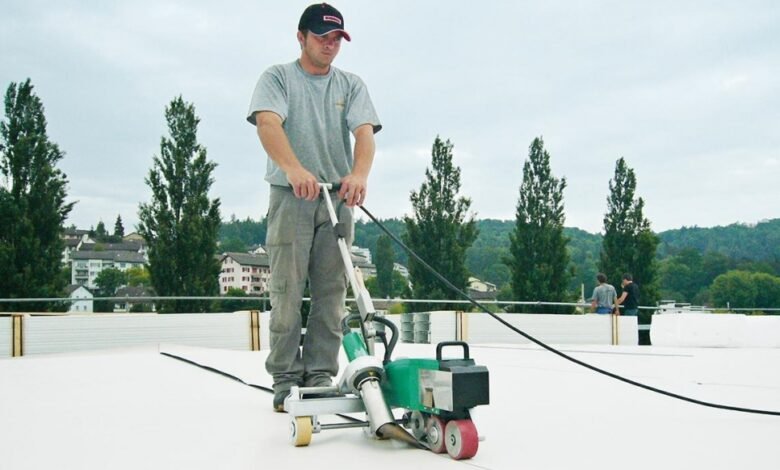
The process uses either a handheld hot-air welder for detail work and shorter runs, or an automated robotic welder for long, straight field seams. The automated welder moves at a consistent speed with consistent heat and pressure applied through a roller, which produces far more uniform results than hand-welding across a long run. Hand welding remains necessary at corners, penetrations, and detail areas where the automated machine can’t manoeuvre, and this is where welding quality varies most between crews.
The variables that determine weld quality
A good weld depends on getting several variables right simultaneously, and getting any one wrong produces a seam that looks acceptable but doesn’t perform. Temperature has to be within the manufacturer’s specified range for that specific membrane, too cool and the material doesn’t fuse, too hot and it scorches or degrades the material at the weld line. Welding speed has to match the temperature setting, since a welder moving too fast at a given temperature doesn’t deliver enough heat, and moving too slow can overheat the seam.
Roller pressure applies the mechanical force that presses the softened material together into a unified bond, and inconsistent pressure produces a seam that’s fused in some spots and merely touching in others. Weather conditions matter too: welding in cold temperatures requires adjusted settings and technique, since the membrane itself starts colder and the ambient heat loss is faster, and a crew running standard summer settings on a cold Calgary shoulder-season day is set up to produce weak seams without necessarily realizing it.
Membrane cleanliness at the seam is the variable most easily overlooked. Dust, moisture, or contamination on the membrane surface at the weld location prevents proper fusion regardless of how correct the temperature and pressure settings are. A rushed installation that doesn’t clean the seam area before welding is compromising the bond before the welder even touches it.
How seam integrity gets tested
Because a weld’s quality isn’t always visible to the eye, the industry uses specific test methods to verify a seam is actually fused rather than just appearing fused. A probe test, run during and after installation, involves running a blunt probe tool along the seam edge, checking for any spot where the probe can slip between the two layers, which indicates an unfused or partially fused section.
- Probe testing every seam, performed by the installing crew as standard quality control during the job, not as an afterthought.
- Peel testing on sample cuts, physically pulling a small seam sample apart to confirm the bond strength meets the manufacturer’s minimum requirement, with the membrane itself failing before the seam does.
- Third-party or owner’s-representative inspection on larger projects, providing an independent verification separate from the installing contractor’s own quality control.
- Manufacturer field inspection, often required to activate an NDL warranty, where the manufacturer’s own representative reviews seam quality before issuing coverage.
A roofing contractor who welds without any documented probe testing, or who can’t describe their seam quality control process clearly, is not demonstrating the rigour a several-hundred-thousand-dollar roof deserves.
Why seams fail years after a roof passes inspection
A seam that passes probe testing at installation can still fail years later, and the mechanisms are worth understanding because they point back to installation quality rather than the material aging normally. Thermal cycling, the expansion and contraction the membrane goes through across Calgary’s wide temperature swings, puts repeated stress on every seam, and a marginally under-welded seam that held together at installation can slowly separate under years of that cycling.
Foot traffic and mechanical stress near seams, particularly around rooftop equipment where service technicians walk repeatedly, accelerate wear at seam locations more than on the open field membrane. And UV exposure, while it affects the whole membrane, can be particularly hard on a seam edge if the weld didn’t achieve full fusion, since a partially bonded seam edge gives UV and moisture a starting point to work from that a fully fused seam doesn’t present.
What to ask about seam quality before and after installation
Before awarding a single-ply re-roof project, ask the contractor directly about their seam quality control process: whether they probe test every seam as standard practice, how they handle cold-weather welding adjustments, and whether they can provide documentation of testing performed. A contractor authorized by the membrane manufacturer, required for an NDL warranty on most systems, has already been vetted on installation competency as part of earning that authorization.
After installation, a periodic inspection that specifically checks seam condition, not just general membrane condition, is worth including in a maintenance program, particularly on roofs with heavy foot traffic near rooftop equipment where seam wear concentrates. Catching a seam that’s beginning to separate before it becomes an active leak is a routine maintenance repair; catching it after is a water intrusion problem with interior damage attached.
Weather windows and the pressure to weld anyway
Calgary’s welding season faces real constraints from the climate, and the pressure to keep a project moving can push crews toward welding in marginal conditions that compromise seam quality. Most membrane manufacturers specify a minimum ambient temperature for reliable welding, and while adjusted technique can extend that window somewhat, there’s a real floor below which a consistent, code-compliant weld becomes difficult regardless of adjustment.
A property manager scheduling a re-roof project should ask how the contractor handles a cold snap or an early snowfall mid-project: whether they pause and protect the exposed work until conditions improve, or push forward with adjusted settings that may or may not fully compensate. A contractor with a clear, documented cold-weather protocol, rather than one who simply asks the crew to “weld it a bit hotter,” is the one more likely to deliver seams that hold up over the full service life rather than seams that passed a same-day probe test under compromised conditions.
Manufacturer-required sampling on larger projects
Many manufacturers require destructive seam sampling at set intervals on larger commercial projects as a condition of issuing an NDL warranty, a specific number of test cuts per given roof area, evaluated against a minimum peel strength before the warranty is finalized. This is a useful backstop precisely because it’s performed or verified independently of the installing crew’s own quality control, adding a manufacturer-side checkpoint before the warranty ever gets issued.
The membrane is manufactured. The seam is built.
A single-ply roof’s field membrane is a consistent, factory-tested product, but its seams are field-executed joints that depend entirely on the welding crew’s technique, equipment, and quality control on the day of installation. Miles of seam on a large commercial roof mean miles of opportunity for a weak weld to sit undetected until thermal cycling or foot traffic eventually finds it.
A crew that’s trained on commercial roof weatherproofing standards in Calgary set by the manufacturer, and that probe tests every seam and documents the results, gives a building owner confidence the roof’s weakest points, the seams, were built to the same standard as the membrane itself.
About the author: this article was contributed by Superior Roofing Ltd., authorized installers of Carlisle and Duro-Last single-ply systems in Calgary. The team’s Red Seal Journeymen probe test every seam as standard practice and carry $10 million in liability coverage on commercial roofing projects across Alberta.